How Magic Mushrooms Affect Mood and Perception
How Magic Mushrooms Affect Mood and Perception
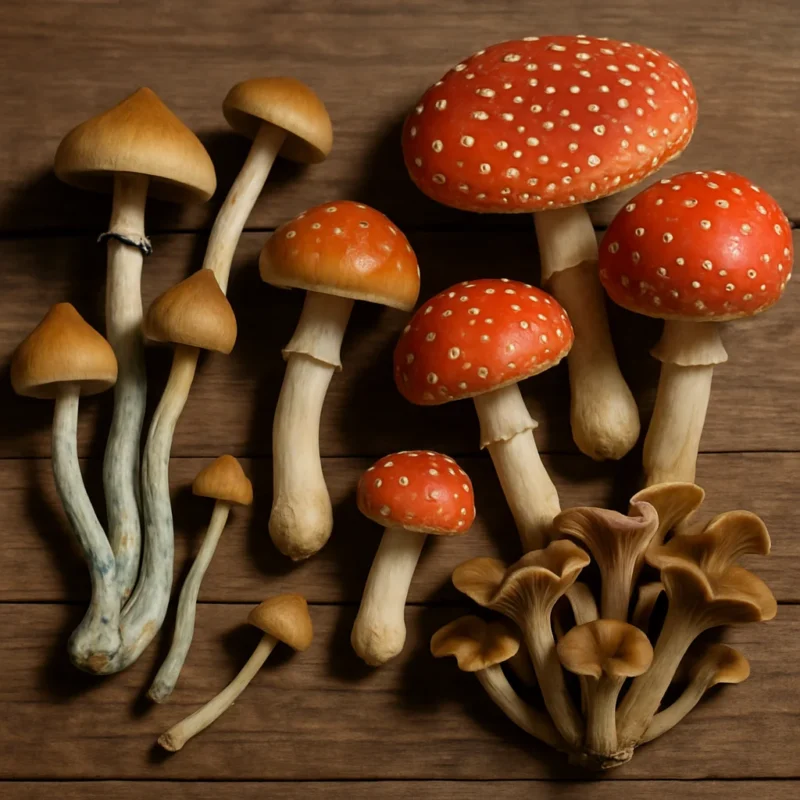
Magic mushrooms contain the psychoactive compound psilocybin, which the body converts into psilocin. Psilocin primarily interacts with serotonin receptors in the brain — especially the 5-HT2A receptor — leading to significant changes in mood, perception, and cognition.
Below is a clear, science-based overview of what happens psychologically and neurologically.
🧠 1. How They Work in the Brain
Psilocybin affects brain communication patterns rather than simply “stimulating” or “depressing” activity.
Research from institutions such as Imperial College London and Johns Hopkins University suggests that psilocybin:
- Disrupts activity in the default mode network (DMN) — the system linked to self-reflection and ego identity
- Increases communication between brain regions that don’t usually interact
- Enhances emotional processing
This altered connectivity is why experiences can feel novel, intense, or deeply meaningful.
😊 2. Effects on Mood
🌈 Positive Mood Changes
Many users report:
- Elevated mood or euphoria
- Increased empathy and emotional openness
- A sense of connectedness (to people, nature, or abstract ideas)
- Enhanced appreciation of music, art, or surroundings
In clinical settings, controlled psilocybin sessions have shown promising results for depression and anxiety — though this occurs under strict medical supervision.
⚠️ Challenging Emotional States
Not all experiences are positive. Psilocybin can also cause:
- Anxiety or panic
- Paranoia
- Emotional overwhelm
- Intensified sadness or fear
Mood effects are highly dependent on “set and setting” (mindset and environment).
👁️ 3. Changes in Perception
Psilocybin strongly alters sensory processing.
🎨 Visual Effects
- Enhanced colors and brightness
- Geometric patterns
- Movement in still objects (e.g., walls “breathing”)
- Closed-eye visual imagery
🔊 Auditory & Sensory Changes
- Sounds may feel deeper or layered
- Music can feel emotionally powerful
- Altered sense of touch or body awareness
⏳ Time & Space Distortion
- Time may feel slowed, sped up, or irrelevant
- Distance and depth perception may shift
- Boundaries between self and environment may feel blurred
🧩 4. Cognitive Effects
Psilocybin can change how thoughts form and connect:
- Increased creativity and novel associations
- Abstract or symbolic thinking
- Reduced rigid thought patterns
- Possible confusion or difficulty concentrating
Some individuals describe “ego dissolution” — a temporary reduction in the sense of a fixed self.
⚠️ 5. Risks and Psychological Considerations
While psilocybin is not considered physically addictive and has low toxicity, psychological risks exist:
- Higher risk for individuals with a history of psychosis or schizophrenia
- Potential for intense distress (“bad trips”)
- Rare but reported cases of persistent perceptual changes (HPPD)
Unpredictability increases if combined with alcohol or other substances.
⏳ 6. Duration of Effects
Typical timeline (varies by dose and individual):
- Onset: 20–60 minutes
- Peak: 2–4 hours
- Total duration: 4–6 hours (sometimes longer)
- After-effects: Emotional sensitivity or reflective mood for several hours or days
🧠 Long-Term Mood Impact (Research Context)
Clinical trials — including studies at Johns Hopkins University — have found that under controlled therapeutic conditions, psilocybin can produce lasting improvements in mood for some patients with depression or anxiety.
However, these results:
- Occur in structured clinical settings
- Include psychological screening
- Involve guided preparation and integration
They are not equivalent to unsupervised recreational use.
📌 Summary
Magic mushrooms affect mood and perception by temporarily reshaping how the brain communicates. Effects can include:
✔ Enhanced emotions and empathy
✔ Visual and sensory alterations
✔ Changes in thought patterns
✔ Distorted sense of time and self
But also:
⚠️ Anxiety or psychological distress
⚠️ Increased risk for vulnerable individuals
⚠️ Highly variable outcomes
The experience depends heavily on mental state, environment, dose, and individual brain chemistry.